The Impostor in the Barbican
“They didn’t bring us across the dark in those pods. They only brought the postcards. And after two years, the ink comes off.”
The rain in New London never fell from a cloud. It sweated off the underside of a million tonnes of lead-doped slag-glass four hundred metres overhead, gathered oil and sulphur from the magnetic deflection coils, and came down through the sodium gloom in a warm, greasy drizzle that tasted of old pennies.
Detective Inspector Arthur Vance stood on the upper gantry outside the Barbican Recital Hall, turning the collar of his wool-blend coat up against the drip, and tried to make his left ring finger hurt.
He flexed it once, twice, pressing the crooked middle knuckle into his palm. Fifteen years ago, in a tiled custody corridor at Deptford Nick, a twenty-stone scaffolder high on bathtub amphetamines had stamped on Vance's hand against an iron drain cover. The bone had set three degrees off-true. For a decade and a half on Earth, that finger had been better than a Met Office barometer; the moment the air turned damp off the Thames, a dull, gravelly toothache would start up in the joint and stay there until April.
Here, four light-years out in the dark, the air was permanently ninety per cent humidity, the gravity pulled at a man's spine with an extra twelve per cent of spite, and the finger felt nothing at all. The knuckle was still crooked—he could see the pale crescent of the old split skin under the amber bulkhead lamp—but inside, the bone was silent. Dead quiet, like an unplugged fridge.
"You're doing the hand thing again, Guv," Detective Sergeant Mairead Sabir said behind him.
Vance dropped his hand into his coat pocket. "Wasn't."
"You were. Standing on the steps like you're trying to remember if you left the immersion heater on in Manchester." Sabir came up beside him under the dripping concrete awning, not even breathing hard after four flights of basalt stairs. She was thirty-one, second-generation Red-Born, with the compact, high-density bone structure of people who had never known Earth's easy one-gee pull. In the spill of the streetlamps her eyes had that wide, dark-iris look native to the Rift—pupils perpetually open to drink in the stingy 3,000-Kelvin light. "Uniform's got the lobby sealed. SOCO's ten minutes behind us—cable-tram's backed up at Vauxhall with a transformer fire. You want a calcium chew before we go in?"
"I don't want a calcium chew, Mairead."
"Your knees clicked on every riser from Level Six."
"They're forty-six-year-old knees. They're entitled to an opinion."
He looked past the iron balustrade before pushing through the swing doors. Because the Barbican sat high on the western wall of the Thames Rift, you could actually see the sky through the ribbed triangles of the canopy above the mid-tier tenements. Proxima Centauri hung where it had hung for four billion years and where it would still be hanging when Vance was ash: three times the width of Earth's sun, swollen and sullen, balanced half-buried in the violet dust-squalls of the western terminator. It didn't shine so much as smoulder, the colour of an iron grate pulled late from a coal fire. Beneath it, six tiers of wet ferro-concrete terraces dropped away into the gorge, stitched together by the orange sparks of welding arcs and the slow, groaning cables of the freight trams.
Fourteen months he had been awake on this rock. Fourteen months, and his brain still waited for the sun to finish setting.
"Right," Vance said, pulling a pair of nitrile gloves from his pocket and snapping them over his wrists. "Give me the sheet."
Sabir flipped open her slate as they stepped out of the roof-rain into the dry, cedar-scented warmth of the Barbican's upper foyer. Down in Basalt Wharf, the municipal corridors smelled of boiled fungal protein and ozone; up here on the starward shelf, where Centauri Starlines subsidised the arts for senior colonial administrators, they had real wood veneer on the bulkheads and full-spectrum circadian chandeliers humming in the plaster coving.
"Nine-nine-nine call came in to Central at nineteen-forty-two," Sabir read, keeping pace with Vance's heavy, flat-footed stride down the carpeted corridor. "Caller was the venue manager, one Thomas Lindqvist. The New London Chamber Sinfornia had Rehearsal Room Three booked from eighteen hundred for tomorrow night's Gala. At nineteen-thirty, the second violinist and the violist went down to the canteen for synth-coffee, leaving the first violinist and the principal cellist alone to work through a transcription."
"Names."
"Deceased is Marcus Sterling. Fifty-four. First chair violin. Formerly of the Academy of St Martin in the Fields." Sabir glanced sideways at Vance. "Suspect in situ is Julian Thorne. Fifty-two. Principal cellist."
Vance slowed half a step. Even if you didn't pay forty colonial credits for a stall seat on the Upper Terrace, you knew the name. Thorne's face had been plastered across every tram platform from Whitehall to Stepney six months ago—part of Centauri Starlines' Heritage in the Rift billboard campaign. A slender, silver-haired patrician cradling a three-hundred-year-old Guadagnini cello against the backdrop of the red dwarf.
"Wait," Vance said. "Sterling and Thorne. They came over together."
"Boat-mates," Sabir confirmed, tapping her screen. "Both arrived aboard the CSL Meridian, Flight 109. Disembarked from Orbital Terminal Acheron twenty-four months and eleven days ago. Cultural sponsorship berth—Starlines waived half their transit bond in exchange for a five-year residency with the Sinfornia. No priors on either of them. Not so much as a late noise complaint. And according to Lindqvist, they've lived together since the Royal Academy in Marylebone. Thirty-two years."
At the end of the corridor, a young Police Constable with a damp hi-vis tunic over his stab vest stood guard outside a pair of heavy acoustic mahogany doors. The lad looked green around the gills.
"He still inside?" Vance asked the PC.
"Yes, sir. Sitting on the piano stool." The constable swallowed hard. "Didn't even ask for a glass of water. Just asked me if I'd mind closing the inner door because the draught from the stairwell was pulling the cello out of tune."
Vance exchanged a look with Sabir, tugged his overshoes on over his brogues, and pushed open the acoustic door.
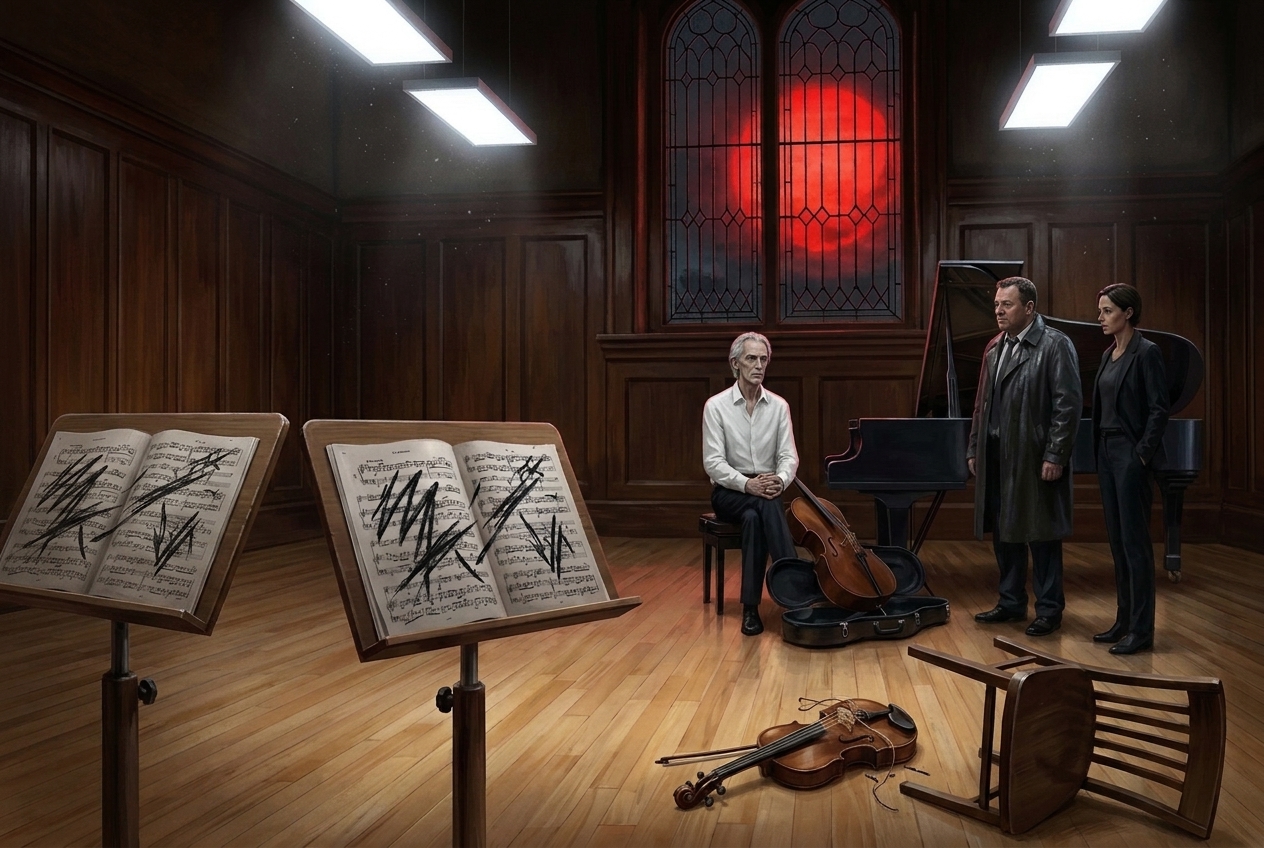
Rehearsal Room Three was built like an airlock within a vault—floating birch floorboards insulated on rubber grommets against the constant, low-frequency rumble of the city's geothermal heat-exchangers far below. The circadian lamps overhead were dialled to a crisp, pitiless 5,500-Kelvin white, mimicking an English June afternoon that no longer existed within twenty-five trillion miles.
In that bright, shadowless light, the blood looked almost black against the blonde wood.
Marcus Sterling lay on his back between two overturned wooden folding chairs, his feet pointing toward the acoustic baffles on the east wall. He was wearing a charcoal cashmere jumper and pressed flannel trousers. His violin—a dark, varnish-crazed instrument that had somehow survived the crossing from Earth in a nitrogen-sealed flight case—lay three feet from his outstretched left hand, its bridge snapped clean in two.
Protruding four inches from the right side of Sterling's neck, just below the angle of the jaw, was the octagonal ebony-and-titanium frog of a cello bow. The shaft had been driven straight through the carotid sheath and into the cervical vertebrae behind it with enough force to snap the carbon-fibre stick mid-length; a bundle of blood-clotted white horsehair hung down across Sterling's collar like a wet beard.
Ten feet away, beside a baby grand piano, Julian Thorne sat with his spine straight and his hands folded palm-up on his knees.
He was fifty-two, tall and narrow-shouldered, wearing a white linen shirt with the sleeves rolled neatly to the elbows. A fine arterial spray had caught him across the left cuff, the collar, and the hollow of his cheek, drying now into dark rusty flakes. His Guadagnini cello rested safely on its side in its velvet-lined carbon cradle behind him, untouched.
Thorne didn't flinch when the door clicked shut. He looked up at Vance with pale grey eyes that were terribly, impeccably calm.
"Inspector," Thorne said. His voice was a cultured Hampstead baritone, slightly hoarse, as if he had been lecturing for an hour. "Watch the resin dust by the second stand, if you would. The cleaner hasn't swept since the matinee."
"Mr Thorne," Vance said quietly. He stopped outside the arc of blood spatter on the birch floor. "I'm Detective Inspector Vance, Basalt Wharf CID. This is Detective Sergeant Sabir. Have you been cautioned by the uniformed officer?"
"He read it off his little plastic card," Thorne said. "Twice, actually. His hands were shaking rather badly the first time."
"Are you injured, Mr Thorne?"
"No."
"Did Mr Sterling come at you with anything? Was there an argument?"
Thorne blinked slowly, as though Vance had asked him a question in bad French. "An argument? With Marcus? Good heavens, no. You don't argue with a metronome, Inspector. You simply switch it off when the ticking becomes intolerable."
Sabir stepped around the perimeter of the room, her boots making no sound on the floating floor, checking the ventilation grilles and the secondary fire exit—bolted from the inside. She stopped behind the pair of wooden music stands still upright near Sterling's boots.
"Guv," Sabir murmured. "Have a look at the score when you've got a second."
Vance didn't take his eyes off Thorne yet. He crouched beside Marcus Sterling's body, keeping his hands clasped behind his back so he wouldn't disturb the primary spatter before SOCO's holocameras arrived.
Up close, the dead man's face was strangely peaceful. No contortion of rage, no bruised knuckles, no skin or fabric fibres under the fingernails of either hand. Even the angle of the puncture told a story before Dr Kwan ever got a scalpel near him: downward at thirty degrees, entering from behind and slightly to the right while Sterling had been seated with his chin on the violin rest.
Sterling hadn't even seen it coming. He had been mid-phrase—his left fingers still curled in the muscle-memory shape of a fourth-position chord—when the man he had shared thirty-two years of his life with had stood up, walked two paces behind his chair, and punched the reinforced metal end of a bow through his throat.
Vance rose slowly, his knees giving the dull, wet clack Sabir had complained about on the stairs, and stepped over to the music stands.
On the left stand sat the violin part for an arrangement of Bach's Partita No. 2 in D Minor—Chaconne, transcribed for violin and cello. Sterling's copy was clean, printed on crisp synthetic parchment with neat, decades-old pencil bowings transferred from his London plates.
On the right stand sat Julian Thorne's cello part.
Vance frowned, leaning closer.
The score was almost illegible beneath a dense, violent storm of black charcoal pencil. Every bar had been crossed out, re-barred, and annotated with cramped, jagged microtonal accidentals—quarter-tone flats, arrows pointing down between the staves, frantic numbers scribbled over the bass clef. Along the bottom margin of the second page, the pencil lead had been pressed hard enough to tear right through the parchment:
THE PITCH IS 440. THE TIMBER IS DEAD.
WHY DOESN'T THE C-STRING ACHE?
THE NOTES ARE ACCURATE. WHY IS THE ROOM EMPTY?
And in the top right corner, boxed three times in heavy black strokes:
IT KNOWS WHERE HE KEPT HIS SPECTACLES. IT DOESN'T KNOW WHY.
Vance stared at the torn paper for a long moment. Behind his breastbone, something small and cold shifted—not a thought yet, just the copper's instinct that the room was bigger than the walls around it.
He walked over to the piano stool where Julian Thorne sat waiting.
"Mr Thorne," Vance said. "Stand up for me, please. Keep your hands out in front of you, palms up."
Thorne obeyed without hesitation. Up close, he smelled of sandalwood soap, pine rosin, and the copper-penny stink of drying blood.
Sabir took a pair of clear evidence bags and paper wrist-ties from her scene kit. "Bagging his hands before we move him to Basalt Wharf, Guv?"
"In a second," Vance said.
He reached out—careful not to touch the blood flakes on Thorne's linen cuffs—and held his own gloved palm two inches beneath Thorne's upturned fingers, tilting them slightly toward the 5,500-Kelvin overhead lamp.
Vance knew hands. You didn't spend twelve years working homicides in South London without learning how a man's trade wrote itself into his skeleton. Bricklayers had squared-off, calcified thumb joints and lime-pitted knuckles. Butchers had the network of tiny white diagonal nicks across the non-dominant index finger. And string players—real string players, the lifers who started when they were six years old and spent four hours every morning grinding steel and gut against an ebony fingerboard—had fingertips like horn. The skin didn't just blister and harden; over forty years, the deep dermal layers fused into translucent, yellowing pads, the left nail-beds flattened and warped from constant vertical pressure, and the ulnar side of the bow thumb developed a permanent, knotty spur of periosteal bone.
Julian Thorne had calluses on the four fingertips of his left hand. Neat, shallow, uniform ridges of dry white epidermis.
Beneath them, the flesh of the pads was pink, supple, and smooth. The nail-beds were symmetrical and unmarked. The thumb joint of his right hand was as clean and unthickened as a bank clerk's.
They weren't the hands of a fifty-two-year-old master who had played the Royal Albert Hall for thirty summers. They were the hands of a man who had only been playing the cello for two years.
"How long have you played, Julian?" Vance asked softly.
Thorne looked down at his own fingers under the white light. A faint, polite smile touched the corner of his mouth.
"Forty-five years, Inspector. My father bought me a quarter-size instrument in Camden when I was seven. I remember the smell of the glue inside the f-holes. I remember catching my thumb in the tailpiece on my tenth birthday." Thorne raised his eyes to Vance's face. "I have every single one of those memories in my head. Neat as postcards in a shoebox. Just like the thing on the floor over there had all of Marcus's."
"That's Marcus Sterling on the floor, Mr Thorne."
"No," Thorne said gently, almost pityingly. "Marcus died. I think he must have died a very long time ago, before we ever left the Moon. It took me twenty months to realise it, you see, because the imitation was so extraordinarily thorough. It remembered our flat in Belsize Park. It remembered how he used to tap his bow twice against his shoe before the downbeat of the Chaconne. When it spoke to me over breakfast, the cadence was flawless."
Sabir paused with the paper evidence bag open in her hands, her hazel eyes narrowing. "Then how'd you know it wasn't him, Mr Thorne?"
"Because when it played," Thorne whispered, looking past Vance at the broken violin on the birch floor, "nothing came out. And when I looked at its face across the supper table, nothing moved inside my chest. Thirty-two years I loved that man, Sergeant. And four months ago I looked at him and realised I was sitting in a room with a painted radiator that had no fire inside it. A hollow impostor wearing his skin."
Thorne held his hands steady as Sabir slipped the heavy kraft-paper bags over his wrists and taped them snug around his forearms.
He leaned half an inch closer to Vance as the handcuffs clicked home over the paper, his voice dropping to a conversational murmur beneath the hum of the ventilation fans.
"Ask your pathologist to look inside his bones, Inspector. Don't let Starlines take him back to the Spire before you look." Thorne's pale grey eyes dropped briefly to Vance's left hand—to the crooked third knuckle that no longer hurt in the rain—and then came back up to Vance's eyes. "They didn't bring us across the dark in those pods. They only brought the postcards. And after two years, the ink comes off."
